TOEFL Time
What to know about the TOEFL independent writing task
Thirty minutes sounds long, but it goes by so fast and you won't accomplish much if you don't have good writing strategies. In this section, we have listed three steps that can help you rock the independent writing section. We have also provided some samples and practices to check your understanding!
Step 1: Prewriting (3 minutes)
A good outline will make your writing process more efficient. Even though your time is limited, you can still take three minutes to build an outline. There are three things you should write in three minutes. We call them 3 for 3:
-
Your position
-
Your supporting details
-
Your topic sentences
Example
Prompt: The COVID-19 vaccination should be made mandatory for everyone. Do you agree or disagree with this statement?
-
Your position: "Agree"
-
Your supporting details - What if you don't know what points you should give to support your position? Here is a writing tip for you!
Writing Tip #1
Think about how your position affects the four aspects of life (work, health, learning, and family).
Position + supporting ideas make a thesis statement. Remember, it's better to have well-developed paragraphs than just a long essay. Therefore, choose two (or a maximum of three) of the ideas above and pack the ideas into a thesis statement. In our case, the thesis statement can be
-
Everyone should be required to get COVID shots because vaccination can improve work efficiency and family relationships.
If time allows, you can start writing topic sentences for each paragraph. If you are unfamiliar with thesis statements and topic sentences, the next section will help you!

Step 2: Drafting (20 minutes)
A standard TOEFL independent writing essay will have about 350-400 words. Based on this word count, we have broken down approximately how many words you should have in each section.
-
Introduction – 50 words
-
Body Paragraph 1 – 150 words
-
Body Paragraph 2 – 150 words
-
Conclusion (optional) – 50 words
What should you write in each paragraph? Here's a chart for you to see what should be in each paragraph. Remember, this chart only serves as a guide to show you what an organized essay looks like; you don't have to follow this structure. If you find another more effective way to organize your essay, go ahead and use it! If you struggle to write clearly, following this chart will be a good start.
-
A thesis statement tells the readers (1) your position and (2) your reasons.
-
Ex. Everyone should be required to get COVID shots because vaccination can improve work efficiency and family relationships.
-
-
A topic sentence begins each body paragraph. It tells the reader what that paragraph will focus on.
-
Ex. COVID shots should be mandatory because employees will have higher working performance.
-
Ex. COVID shots should be manadatory because families will have fewer conflicts.
-
-
A concluding sentence concludes each body paragraph. It reminds the readers what that paragraph focused on. Basically, you rephrase what has been said in the topic sentence.
-
Ex. When everyone is vaccinated, companies will achieve better financial results.
-
Ex. When everyone is vaccinated, families will be more harmonious.
-
-
A thesis restatement restates the main points of an essay. Basically, you rephrase what has been said in the thesis.
-
Ex. COVID vaccination should be required so that staff can make higher contributions to the company and families can have stronger relationships.
-
You may wonder what the difference between reason and example is. A reason is a more general statement while the example is an elaboration. An example can be what is happening around the world or what happened to you.
Writing Tip #2
Concrete examples are more persuasive than personal examples. See the difference between the following two examples.
-
My uncle has always been sick his whole life. He had COVID because he was in contact with a friend who was exposed to the virus. Since my uncle did not take the vaccination, he got very serious symptoms. Even though he has recovered now, he feels a lot weaker than before.
-
When people with low immune systems get exposed to the virus, they get stronger symptoms, which might make them not fully recover from COVID. However, vaccination can protect these people from the virus.
Generalizing the example makes a stronger argument. Now, it is not only your uncle's problem; it is everyone's.

Step 3: Revising (7 minutes)
After you have drafted your essay, use the remaining time (hopefully you will have at least 7 minutes left) to revise the writing. You can check your grammatical usage, vocabulary usage, spelling, and sentence variety. You may have to work on the first three areas on your own. What we will focus on practicing in this section is using a wide variety of sentence structures.
Look at the difference between the following two bullet points:
-
I personally agree that vaccination should be made mandatory. I think vaccination will allow us to return to in-person learning. I took online classes for two semesters. I hated it. I did not make any friends or get to know any professors. I don't think I learned anything.
-
If vaccination is made mandatory, students can return to in-person learning. My experience of taking online classes for two semesters was miserable. Not only did I miss out on the opportunity to make friends or know any professors, but I also did not get a lot out of the classes.
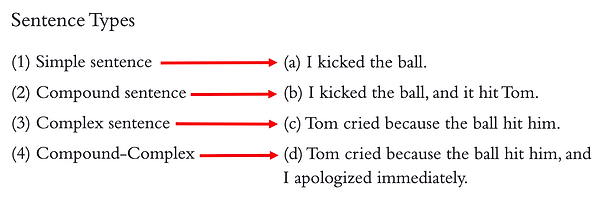
In the second bullet point, we made use of different sentence structures. Let's look at some examples of different sentence structures.
-
Simple Sentence – One complete sentence
-
Compound Sentence – Two complete sentences joined together by coordinating conjunctions: FANBOYS
-
FANBOYS = For, And, Nor, But, Or, Yet, So
-
-
Complex Sentence – One complete sentence + one or more incomplete sentences. Joined by subordinating conjunctions, e.g., while, because, when, although, even though, as soon as, etc.
-
Compound-Complex Sentence – A combination of a compound and a complex sentence
Writing Tip #3
TOEFL raters do not like it when you copy and paste or use the exact same wording as the prompt. They want you to show your vocabulary knowledge by using different words. Also, try not to use the same word over and over again. Use its synonyms. Look at the following examples:
-
vaccination, shots, vaccine
-
schools, institutions, colleges
-
teachers, instructors, educators
-
employee, staff, workers
-
relationships, bonding
Rubric

Samples
Now that we have gone through all the writing steps, let's look at some samples and identify the strengths and weaknesses of each sample. We have included comments at the end of each writing sample to help you understand why that writing is given a certain score. Remember, none of these essays is perfect. Also, don't attempt to use any memorized sentences or phrases for your independent writing exam. Memorized stuff is things you memorize before going to the test center. Do not try to write anything you would not have written if you did not memorize it.


Score 5
Score 4
Score 3
Score 2
Understanding the TOEFL independent writing rubric and how essays are scored will help you be more prepared to write well yourself. Read through the rubric above, then take this quiz to practice applying the rubric!
Practice
Let's practice what you just learned together. In this section, you will be guided through a sample question. You can find more sample questions on the websites provided in Resources. Open a new word document and start typing!
Start the timer and start typing the following things on your document.
-
Your position
-
Your supporting details
-
Your topic sentences
Start the timer and start typing the rest of your essay.
Start the timer and start revising and editing your essay.